Privacy-first · Evidence-based

Your mind,
prepared
for what's next

Think Cue connects to your calendar and delivers science-based psychological techniques exactly before each event — without adding another layer of noise to your day.

Free to start
iOS 17+
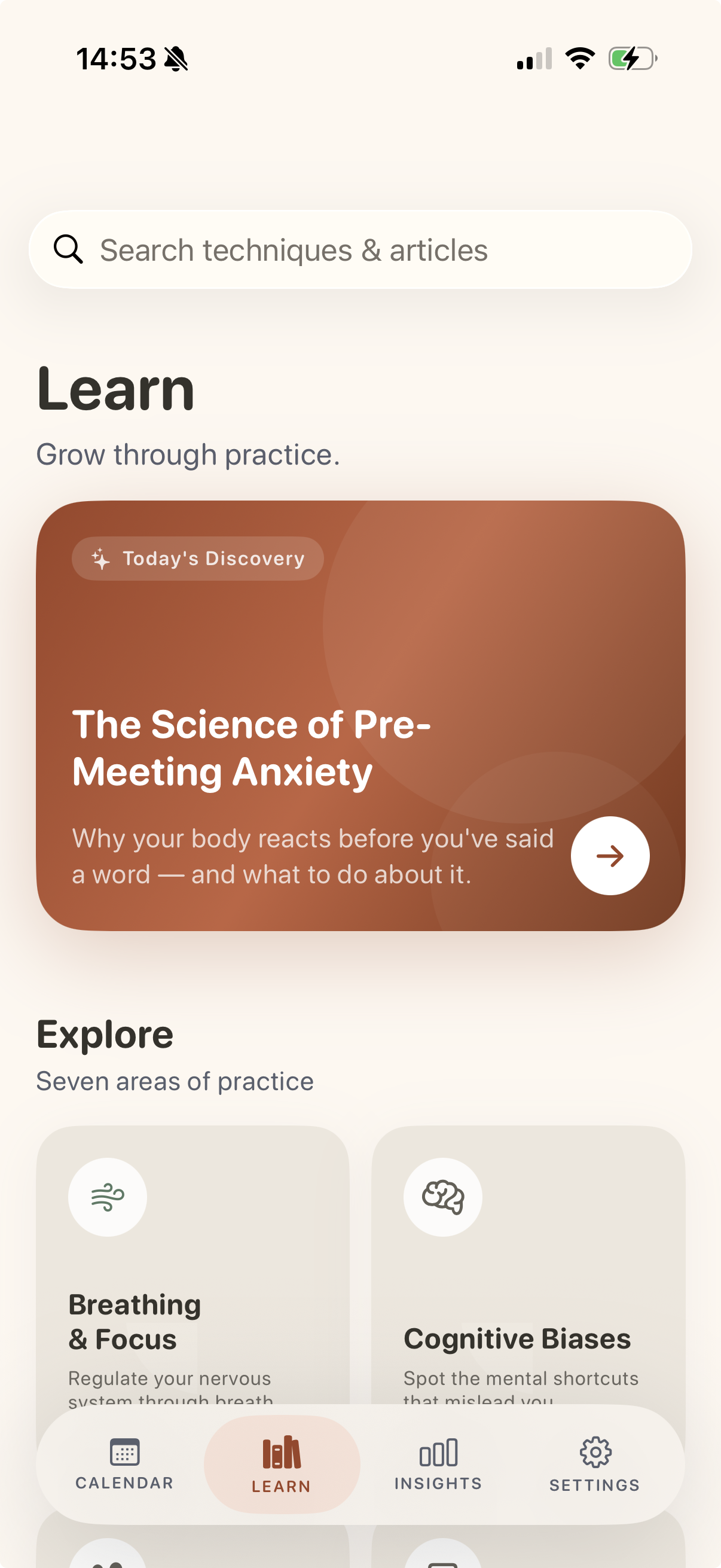
Learn tab
Home screen
See it in action

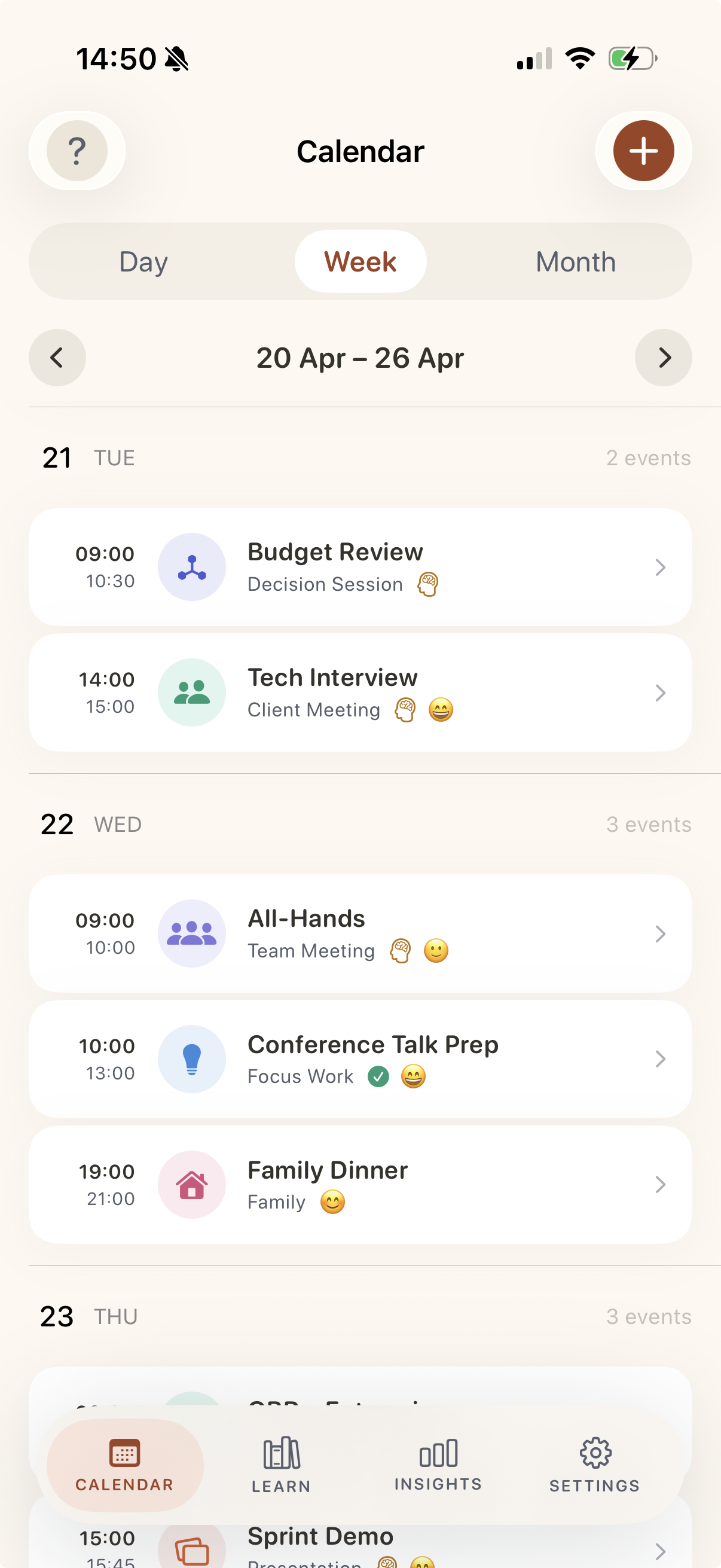
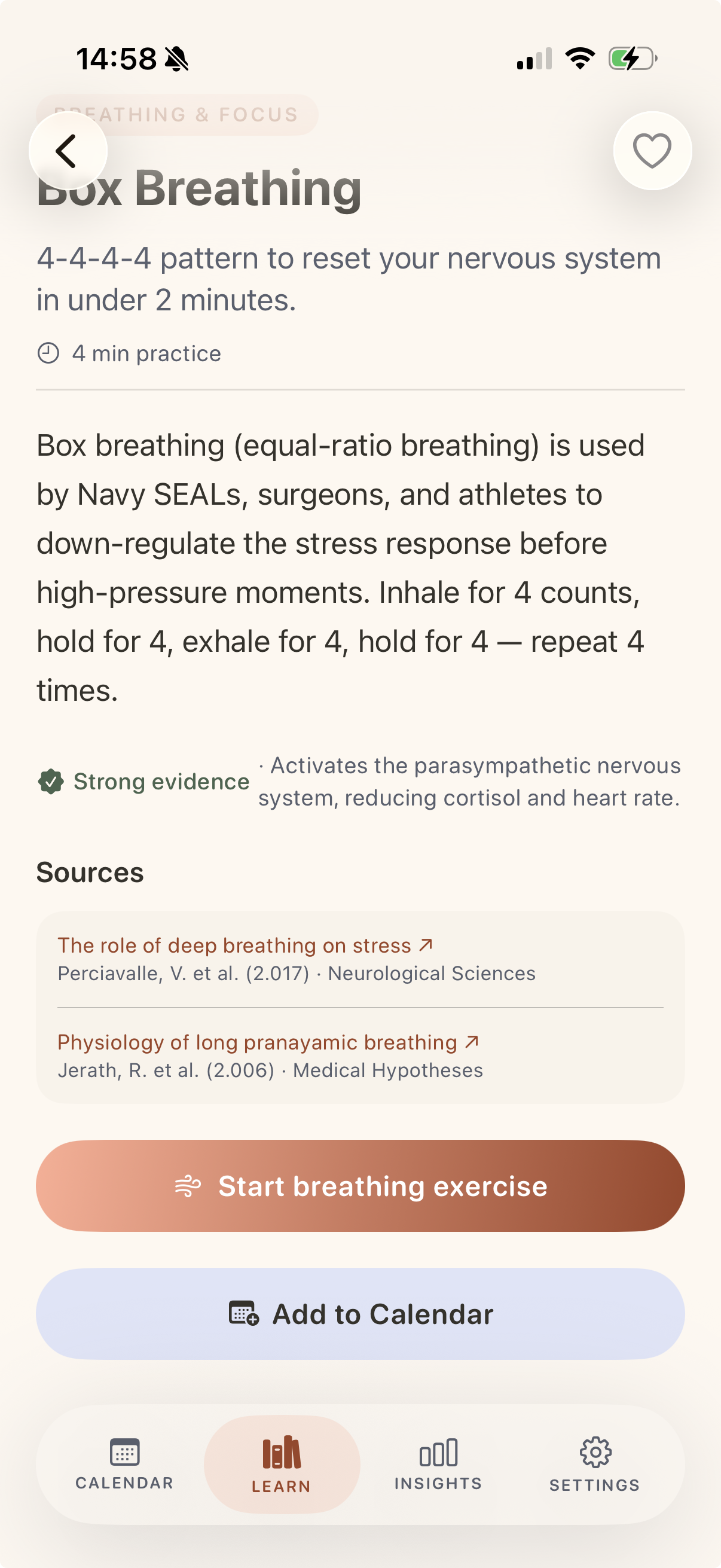
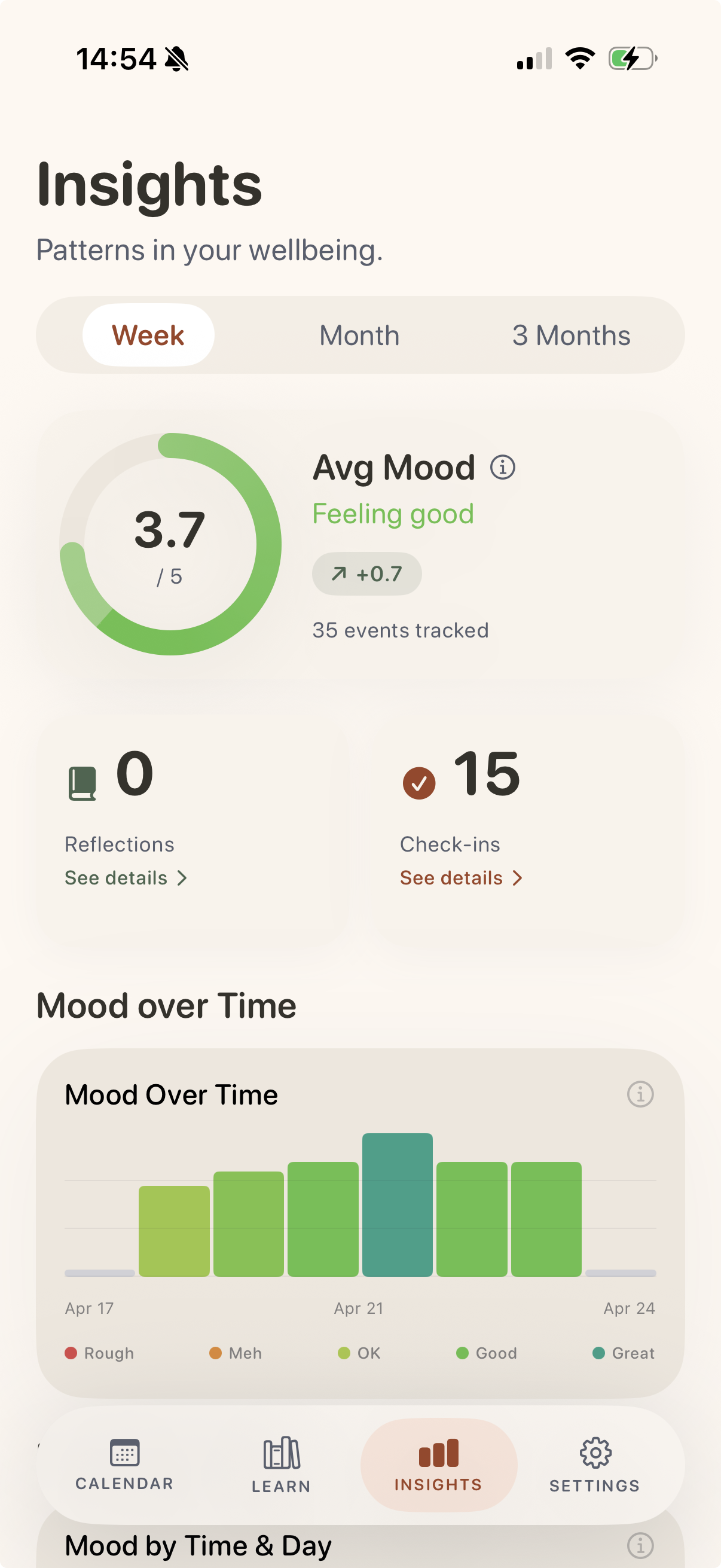
The app, in your hands

Four views. One purpose: make each day a little more prepared.

Our philosophy

Not another layer of complexity.
A preparation system.

Most wellness apps want your time, your streaks, your attention. Think Cue wants none of that. It shows up precisely when relevant — and stays quiet the rest of the time.

01
In-context, not in-demand

Evidence shows psychological interventions are most effective when delivered in a context similar to the situation they prepare you for. A breathing technique before a stressful meeting lands differently than one learned at random.

02
Reflection without friction

The ABC model — Activating event, Belief, Consequence — is one of CBT's most powerful tools. Think Cue surfaces it precisely after an event, when reflection is natural and memory is fresh.

03
No gamification, no fatigue

Streaks, badges and daily pressure create notification fatigue — backed by research. We don't push you. Insights emerge naturally from your calendar data. Knowledge is there when you reach for it.

Help people understand their behaviour, thoughts and psychological patterns — and be ready for each day.

  • Use Think Cue's built-in calendar, or optionally connect your iOS calendar — your choice
  • Receive a science-based technique minutes before each event type
  • Reflect using the structured ABC journal immediately after
  • Watch simple, honest insights emerge over time
  • Browse a deep library of techniques and articles
  • No ads. No data selling. Your journal never leaves your device.
What's inside

Everything you need.
Nothing you don't.

Core

Built-in calendar — iOS sync optional

Think Cue ships with its own calendar, so you can start using it immediately without connecting anything. If you prefer, connect your iOS Calendar in one tap — Think Cue will read upcoming events and automatically assign a psychological category and relevant technique. Add events directly in the app or in any app you already use — everything stays in sync.

📅 Synced from iOS CalendarEvents appear automatically
🤖 Auto-classifiedOn-device, deterministic
💡 Technique deliveredBefore each event type
Science

Evidence-based techniques

Every technique and article is drawn from peer-reviewed research — CBT, ACT, mindfulness, stress inoculation, physiological regulation. Curated by practitioners, not algorithm alone.

CBT ACT Mindfulness Box Breathing Stress Inoculation Body Scan

Privacy by design

AES-256 encryption. Journal stays on-device only. iCloud Keychain sync. No data ever sold.

Meaningful insights

Weekly and monthly reports on mood trends, stress by category, technique effectiveness — without manufactured urgency. Simple truth about your patterns.

Actionable library

Browse techniques and long-form articles. Add any technique directly to your calendar as a recurring practice — build mastery over time.

Built with advanced tech — shipped without it

We used modern research tools and large-scale models during design and content curation, but the app you install does not call them at runtime. Every classification, recommendation, and insight is computed on-device using deterministic, auditable rules — because privacy beats convenience for the data that matters most.

On-deviceAlways
  • Rule-based event classification
  • Survey-based personalisation
  • Deterministic technique matching
Off-deviceNever
  • No model inference at runtime
  • No journal content sent anywhere
  • No third-party recommendation engines

ABC journal — local, always

After each event, reflect using the Activating Event → Belief → Consequence framework. Journal entries are encrypted and stored exclusively on your device. They never reach any server — ours or anyone else's.

Example reflection
A: Back-to-back meetings drained my focus
B: "I should have prepared more"
C: Anxious, distracted all afternoon
By the numbers

Built on real research

Every technique, every insight, every recommendation traces back to peer-reviewed evidence. This is not wellness content — it is applied behavioural science.

37
Peer-reviewed research papers and meta-analyses reviewed
6
Evidence-based therapeutic frameworks applied
30+
Techniques and exercises curated
0
Gamification mechanics. None. On purpose.
2025
Systematic review and meta-analysis of educational approaches to reduce cognitive biases among students
Swaryandini et al.
Nature Human Behaviour — 54 RCTs, n=10,941 on cognitive debiasing
2024
Implementation of mindfulness-based emotion regulation strategies: A systematic review and meta-analysis
Raugh et al.
Affective Science — 110 studies, n=8,105 on emotion regulation
2023
Brief structured respiration practices enhance mood and reduce physiological arousal
Balban et al.
Cell Reports Medicine — basis for physiological sigh technique
2023
Effect of breathwork on stress and mental health: A meta-analysis of randomised-controlled trials
Fincham et al.
Scientific Reports — 12 RCTs on breathwork and mental health
2012
The Efficacy of Cognitive Behavioral Therapy: A Review of Meta-analyses
Hofmann, Asnaani, Vonk, Sawyer, Fang
Cognitive Therapy and Research — 269 meta-analyses reviewed
Privacy-first

Your mind's data stays
where it belongs

Psychological data is among the most sensitive that exists. We engineered every layer of Think Cue around that fact — not as a feature, as a foundation.

Data architecture
Journal entries (ABC)Device only, encrypted
Survey answersEncrypted in cloud storage
Event titlesEncrypted in cloud storage
Mood check-insEncrypted in cloud storage
Participant namesEncrypted
AES-256-GCM encryption

All sensitive fields — event titles, mood check-ins, survey answers — encrypted before leaving your device. The key lives in your iCloud Keychain, end-to-end encrypted by Apple.

Journal never leaves your device

ABC journal entries are stored exclusively in secure local storage on your iPhone. They are never synced to any server or cloud service — no way for anyone, including us, to read them. Entries are AES-256 encrypted at rest, so even standard device backups contain only unreadable ciphertext.

No third-party model calls

The app does not call third-party model APIs at runtime. There is no inference pipeline, no prompt logging, no external recommendation service. Classification and personalisation run entirely on your device using rules you can read.

Full export & deletion

Download all your data as JSON or delete your account — all Firestore collections purged server-side within seconds. You are always in control.

Real scenarios

Your day, supported

Four moments where preparation changes the outcome. Each one familiar. Each one better with thirty seconds of science.

Scenario 01
Client meeting at 10:00
🤝

It's 09:45. You've been in back-to-back calls since 8am. A major client presents a new brief in fifteen minutes and your mind is still replaying the last meeting's tension. You feel rushed and not quite present.

Think Cue: A notification at 09:47 — "Before your client meeting: Physiological sigh — two quick inhales, one long exhale. A brief breathing reset before you walk in." One tap, one technique. You arrive calmer, more present, ready to listen.
09:47 · Client Review · 1 hr Physiological Sigh A brief breathing reset before the meeting begins. 13 min before event
Scenario 02
Team meeting at 14:00
👥

Last week someone challenged your idea publicly and you're still carrying the sting. You want to contribute openly but notice yourself already preparing defensive responses instead of genuinely listening.

Think Cue: "Before your team meeting: Perspective check — name one assumption you're bringing in. Is it fact or interpretation?" The ABC framing helps you spot the belief before it shapes your behaviour. You enter curious, not guarded.
13:42 · Team Meeting · 45 min Perspective Check A — You expect criticism B — "I'll be judged harshly" Is that fact or interpretation? 18 min before event
Scenario 03
Focus block at 09:00
🧠

You've blocked two hours for deep work. But you checked Slack at 8:55 and three threads are running in your head. The block starts in five minutes and you're already fragmented, attention flickering.

Think Cue: "Before your focus block: Diaphragmatic breathing — breathe into your belly for 4 seconds, slow exhale through your nose for 6. Three minutes to settle your attention." You close Slack. You breathe. The threads quiet. You begin.
08:55 · Deep Focus · 2 hr Diaphragmatic Breathing Belly breathing · 3 minutes Settle your attention before deep work 5 min before event
Scenario 04
Decision session at 16:00
⚖️

A significant hiring decision. You've narrowed it to two candidates and you have a strong gut favourite. But you've been in meetings since 10am and you notice you're drawn to the simpler choice, not necessarily the right one. You're not sure if it's judgement or fatigue talking.

Think Cue: "Before your decision session: Consider the opposite — what's the strongest case for the candidate you're leaning against? What would prove your current favourite wrong?" You pause. You write two sentences. The decision feels less automatic and more deliberate.
15:50 · Decision · 30 min Consider the Opposite What's the strongest case against your current favourite? Debiasing prompt · 30 seconds 10 min before event
Foundation

What we built on

Think Cue is the product of curating decades of behavioural science into something practical. These are the domains — and the studies — that shaped every design decision.

CBT Stress Regulation Workplace Mindfulness Decision Science Emotion Regulation Cognitive Debiasing Attention Research Timing of Interventions
Core frameworks
CBT
Cognitive Behavioural Therapy — foundation of the ABC journal and belief-challenging structure
ACT
Acceptance and Commitment Therapy — psychological flexibility and value-based action
SIT
Stress Inoculation Training — preparing for stressful events through graduated exposure and coping rehearsal
MBSR
Mindfulness-Based Stress Reduction — body scan, breathing and present-moment awareness
Respiration & Arousal
Brief structured respiration practices enhance mood and reduce physiological arousal
Balban et al. · 2023 · Cell Reports Medicine
Cyclic sighing produced significantly greater mood improvement (p < 0.05) and respiratory rate reduction versus mindfulness meditation in an RCT with 108 participants.
Workplace Mindfulness
Benefits of mindfulness at work: emotion regulation, exhaustion, and job satisfaction
Hülsheger et al. · 2013 · Journal of Applied Psychology
Brief mindfulness exercises between demanding tasks reduced emotional exhaustion and improved job satisfaction.
CBT Effectiveness
The Efficacy of Cognitive Behavioral Therapy: A Review of Meta-analyses
Hofmann et al. · 2012 · Cognitive Therapy and Research
CBT is highly effective across anxiety, depression and stress — with strong evidence across 269 meta-analytic studies.
Breathwork Meta-Analysis
Effect of breathwork on stress and mental health: A meta-analysis of randomised-controlled trials
Fincham et al. · 2023 · Scientific Reports
Breathwork significantly reduced stress (12 RCTs, n=785, g=−0.35), anxiety (k=20, g=−0.32), and depression (k=18, g=−0.40) versus controls.
Cognitive Fatigue
Mental fatigue and the control of cognitive processes
Van der Linden et al. · 2003 · Acta Psychologica
Mental fatigue significantly impairs executive function and planning — validating that end-of-day decision quality decreases measurably.
Context Learning
Context-dependent memory in two natural environments: on land and underwater
Godden & Baddeley · 1975 · British Journal of Psychology
Information is recalled most effectively in the same context in which it was learned — a classic finding supporting in-context intervention design.
Emotion Regulation
Emotion regulation in current and remitted depression: A systematic review and meta-analysis
Visted et al. · 2018 · Frontiers in Psychology
Across 72 studies, individuals with depression used significantly less reappraisal (g=−0.7) and more rumination (g=2.1) — confirming emotion regulation as a core resilience skill.
Cognitive Debiasing
Systematic review and meta-analysis of educational approaches to reduce cognitive biases among students
Swaryandini et al. · 2025 · Nature Human Behaviour
Across 54 RCTs (n=10,941), educational interventions produced a significant reduction in bias likelihood (g=0.26) — structured prompts at the point of decision are most effective.
App-Based Mindfulness
Mobile mindfulness meditation: A randomised controlled trial of the effect of two popular apps on mental health
Flett et al. · 2018 · Mindfulness
App-based mindfulness improved depressive symptoms and mindfulness in 208 students — but usage dropped below 20% without structured triggers, validating calendar-linked delivery.
Transparency

How everything works

Every algorithm, scoring system and data decision is documented here. No black boxes — you should understand exactly what happens with your data and how recommendations are generated.

Quick facts
✓ No third-party model calls at runtime
✓ Survey data encrypted on-device
✓ All scoring rules are deterministic
✓ Built with modern tools, shipped without them

Events are classified into one of 8 categories: Meeting, Communication, Focus, Decision, Learning, Administrative, Personal, and Wellbeing.

A rule-based engine matches event title keywords against category patterns. Words like "standup", "sync", "review" match Communication; "write", "code", "design" match Focus; "decide", "vote" match Decision. Runs entirely on-device with no network calls.

Each technique has a set of event categories it is relevant to, plus a type tag (breathing, mindfulness, cognitive, physical, journaling, or planning).

Techniques are filtered by matching event category, then re-ranked on-device by your survey preferences (learning style, prior experience). Back-to-back events prioritise quick (≤5 min) techniques. The matching logic is deterministic and runs locally — no model inference, no network calls.

The notification is delivered 15 minutes before the event, or 30 minutes for longer (>1 hour) events.

The SurveyPersonalisation engine scores every bundled technique against your survey answers using a deterministic, additive algorithm. Signals include primary goal match, stress trigger overlap, learning preference, prior experience level, and work context. Techniques are ranked by score and sliced to a display limit (default 6); ties are broken by duration — shorter first for busy-day users. The full scoring logic is documented and auditable on request.

Average mood: Mean of all check-in ratings (1–5) in the selected period.

Stress by category: For each event category, average the stress rating from post-event check-ins. Highest average is flagged "most stressful category."

Technique effectiveness: For each technique, count helpful marks vs. total uses. helpfulRate = helpfulCount / timesUsed. Minimum 3 uses before appearing in rankings.

Mood trend: Linear regression across the period. "Improving", "declining", or "stable" based on slope (>0.2/day = improving, <−0.2 = declining).

Mood heatmap: Events grouped by day-of-week and time slot (morning / afternoon / evening). Each cell shows average mood for check-ins in that slot.

Survey personalisation: If you have survey data, the scoring engine ranks eligible articles and picks the highest-scoring one appropriate for today's slot, rather than purely sequential rotation.

Based on Aaron Beck's cognitive model and Albert Ellis's REBT. After each event you record:

A — Activating Event: What specifically happened? (facts only)
B — Belief: What did you tell yourself in that moment?
C — Consequence: What did you feel and do as a result?

An optional fourth field records an alternative thought — a more balanced interpretation.

Storage: Entries are stored exclusively in secure local storage on your iPhone, encrypted with AES-256-GCM. They are never synced to any server, never included in any API call. Standard device backups (iCloud Backup) may contain the encrypted file, but without your iCloud Keychain key it is unreadable ciphertext. Deleting your account also wipes the local journal from your device.

Think Cue uses AES-256-GCM (authenticated encryption — any tampering with ciphertext is detectable). A 256-bit symmetric key is generated on first launch and stored in your iCloud Keychain. This means the key is:

· End-to-end encrypted by Apple before leaving your device
· Automatically synced to all your Apple devices via iCloud Keychain
· Restored automatically on reinstall if iCloud is signed in
· Never visible to Think Cue or any third party

Journal entries do not sync across devices by design — privacy over convenience for the most sensitive data.

Every technique, article, and recommendation in Think Cue traces back to peer-reviewed research. Below is the full list of studies reviewed, formatted in APA 7th edition style. This list is updated as new evidence is incorporated.

Acciarini, C., Brunetta, F., & Bonfiglioli, R. (2020). Cognitive biases and decision-making strategies in times of change: A systematic literature review. Management Decision, 59(3), 638–652.

Balban, M. Y., Neri, E., Kogon, M. M., Weed, L., Nourber, B., Jo, B., Holl, G., Zeitzer, J. M., Spiegel, D., & Huberman, A. D. (2023). Brief structured respiration practices enhance mood and reduce physiological arousal. Cell Reports Medicine, 4(1), 100895.

Bentley, T. G. K., D'Andrea-Penna, G., Rakic, M., Arce, N., LaFaille, M., Berman, R., Cooley, K., & Sprimont, P. (2023). Breathing practices for stress and anxiety reduction: Conceptual framework of implementation guidelines based on a systematic review of the published literature. Brain Sciences, 13(12), 1612.

Birdee, G. S., Cai, H., Bauer, B. A., Sohl, S. J., Mathieu-Bolh, N., & Gould, M. (2023). A randomized controlled trial of a breathing intervention to promote slow breathing adherence and assess the impact on anxiety symptoms. Complementary Therapies in Medicine, 75, 102959.

Blumenthal-Barby, J. S., & Krieger, H. (2015). Cognitive biases and heuristics in medical decision making: A critical review using a systematic search strategy. Medical Decision Making, 35(4), 539–557.

Chen, B., Yang, T., Xiao, L., Xu, C., & Zhu, C. (2023). Effects of mobile mindfulness meditation on the mental health of university students: Systematic review and meta-analysis. Journal of Medical Internet Research, 25, e39128.

Daros, A. R., Daniel, K. E., Engel, R. A., & Ehrenreich-May, J. (2021). A meta-analysis of emotional regulation outcomes in psychological interventions for youth with depression and anxiety. Nature Human Behaviour, 5(10), 1443–1457.

Demir, S., & Ercan, F. (2022). The effectiveness of cognitive behavioral therapy-based group counseling on depressive symptomatology, anxiety levels, automatic thoughts, and coping ways: A randomized controlled trial. Perspectives in Psychiatric Care, 58(4), 2478–2487.

Economides, M., Martman, J., Saunders, M. J., & Cavanagh, K. (2018). Improvements in stress, affect, and irritability following brief use of a mindfulness-based smartphone app: A randomized controlled trial. Mindfulness, 9(5), 1584–1593.

Fincham, G. W., Strauss, C., Montero-Marin, J., & Cavanagh, K. (2023). Effect of breathwork on stress and mental health: A meta-analysis of randomised-controlled trials. Scientific Reports, 13, 432.

Flett, J. A. M., Hayne, H., Riordan, B. C., Thompson, L. M., & Conner, T. S. (2018). Mobile mindfulness meditation: A randomised controlled trial of the effect of two popular apps on mental health. Mindfulness, 10(5), 863–876.

Fuhrmann, L. M., Ebert, D. D., & Harrer, M. (2025). Evaluating a brief smartphone-based stress management intervention with heart rate biofeedback from built-in sensors in a three arm randomized controlled trial. Scientific Reports, 15, 21472.

Godden, D. R., & Baddeley, A. D. (1975). Context-dependent memory in two natural environments: On land and underwater. British Journal of Psychology, 66(3), 325–331.

Goldberg, S. B., Imhoff-Smith, T., Bolt, D. M., Wilson-Mendenhall, C. D., Dahl, C. J., Davidson, R. J., & Rosenkranz, M. A. (2020). Testing the efficacy of a multicomponent, self-guided, smartphone-based meditation app: Three-armed randomized controlled trial. JMIR Mental Health, 7(11), e23825.

Hofmann, S. G., Asnaani, A., Vonk, I. J. J., Sawyer, A. T., & Fang, A. (2012). The efficacy of cognitive behavioral therapy: A review of meta-analyses. Cognitive Therapy and Research, 36(5), 427–440.

Hülsheger, U. R., Alberts, H. J. E. M., Feinholdt, A., & Lang, J. W. B. (2013). Benefits of mindfulness at work: The role of mindfulness in emotion regulation, emotional exhaustion, and job satisfaction. Journal of Applied Psychology, 98(2), 310–325.

King, D. L., Delfabbro, P. H., Billieux, J., & Potenza, M. N. (2024). A systematic review of the nature and efficacy of Rational Emotive Behaviour Therapy interventions. PLOS ONE, 19(7), e0306835.

Lehrer, P., Kaur, K., Sharma, A., Shah, K., Huseby, R., Bhavsar, J., & Zhang, Y. (2020). Heart rate variability biofeedback improves emotional and physical health and performance: A systematic review and meta-analysis. Applied Psychophysiology and Biofeedback, 45(3), 109–129.

Longmire, N. H., & Harrison, D. A. (2018). Seeing their side versus feeling their pain: Differential consequences of perspective-taking and empathy at work. Journal of Applied Psychology, 103(8), 894–915.

Ludolph, R., & Schulz, P. J. (2018). Debiasing health-related judgments and decision making: A systematic review. Medical Decision Making, 38(1), 3–13.

Ma, X., Yue, Z.-Q., Gong, Z.-Q., Zhang, H., Duan, N.-Y., Shi, Y.-T., Wei, G.-X., & Li, Y.-F. (2017). The effect of diaphragmatic breathing on attention, negative affect and stress in healthy adults. Frontiers in Psychology, 8, 874.

Merla, I., Gabbert, F., & Scott, A. J. (2025). Interventions to reduce implicit bias in high-stakes professional judgements: A systematic review. Behavioral Sciences, 15(11), 1592.

O'Daffer, A., Colt, S. F., Wasil, A. R., & Luo, A. (2022). Efficacy and mechanisms of digital mindfulness interventions: A systematic review and meta-analysis. JMIR Mental Health, 9(4), e36631.

Pilcher, J. J., Baker, V. C., & Roll, J. D. (2025). Brief slow-paced breathing improves working memory, mood, and stress in college students. Anxiety, Stress, & Coping, 38(5), 528–543.

Pop, G. V., Szentágotai-Tătar, A., & Visu-Petra, L. (2025). Anger and emotion regulation strategies: A meta-analysis. Scientific Reports, 15, 6491.

Raugh, I. M., Berglund, A. M., & Strauss, G. P. (2024). Implementation of mindfulness-based emotion regulation strategies: A systematic review and meta-analysis. Affective Science, 5(4), 330–345.

Sætrevik, B., Granerud, T., Nijhof, M., & Sandvik, A. (2025). Tactical breathing enhances police performance in a critical incident simulation. Collabra: Psychology, 11(1), 144527.

Sakiris, N., & Berle, D. (2019). A systematic review and meta-analysis of the Unified Protocol as a transdiagnostic emotion regulation based intervention. Clinical Psychology Review, 72, 101751.

Shao, D., Zhang, H.-H., Long, Z.-T., & Li, J. (2024). The effect of slow-paced breathing on cardiovascular and emotion functions: A meta-analysis and systematic review. Mindfulness, 15(1), 61–88.

Sohal, M., Singh, P., Dhillon, B. S., & Gill, H. S. (2022). Efficacy of journaling in the management of mental illness: A systematic review and meta-analysis. Family Medicine and Community Health, 10(1), e001154.

Swaryandini, G., Graham, J., Griffith, S., Oswald, F. L., Costello, T. H., & Pennycook, G. (2025). Systematic review and meta-analysis of educational approaches to reduce cognitive biases among students. Nature Human Behaviour, 9(12), 2510–2538.

Toet, A., Bijlsma, M. J., & van Erp, J. B. F. (2021). "Now you see it, now you don't"—Retention and transfer of cognitive bias mitigation interventions: A systematic literature study. Frontiers in Psychology, 12, 629354.

Van der Linden, D., Frese, M., & Meijman, T. F. (2003). Mental fatigue and the control of cognitive processes: Effects on perseveration and planning. Acta Psychologica, 113(1), 45–65.

Visted, E., Vøllestad, J., Nielsen, M. B., & Schanche, E. (2018). Emotion regulation in current and remitted depression: A systematic review and meta-analysis. Frontiers in Psychology, 9, 756.

Warsitzka, M., Zhang, H., Beersma, B., Freund, P. A., & Trötschel, R. (2024). Expanding the pie or spoiling the cake? How the number of negotiation issues affects integrative bargaining. Journal of Applied Psychology, 109(8), 1224–1249.

Whelehan, D. F., Conlon, K. C., & Ridgway, P. F. (2020). Medicine and heuristics: Cognitive biases and medical decision-making. Irish Journal of Medical Science, 189(4), 1477–1484.

Zhang, D., Lee, E. K. P., Mak, E. C. W., Ho, C. Y., & Wong, S. Y. S. (2021). Mindfulness-based interventions: An overall review. British Medical Bulletin, 138(1), 41–57.

Total: 37 peer-reviewed references. Last verified: April 2026.

The core app is free — calendar sync, all techniques, the ABC journal, insights, and the full article library.

Think Cue is a personal project built out of genuine interest in applying behavioural science to everyday professional life.

Get in touch

Questions, feedback, ideas

Think Cue is a one-person project. Every message is read personally. Whether you have a research suggestion, a bug report, or just want to talk about behavioural science — I'd like to hear from you.

Think Cue
Paweł Rosner
Creator & developer, Think Cue
thinkcue@pm.me
Common topics
🐛 Bug reports
Include your iOS version and a description of what happened vs. what you expected.
📚 Research suggestions
Know a paper that should inform a technique or article? Send it over.
💡 Feature ideas
The bar is: does this reduce complexity, not add it?
🔒 Privacy concerns
If you believe there is a privacy or security issue, please email directly — not via public channels.